
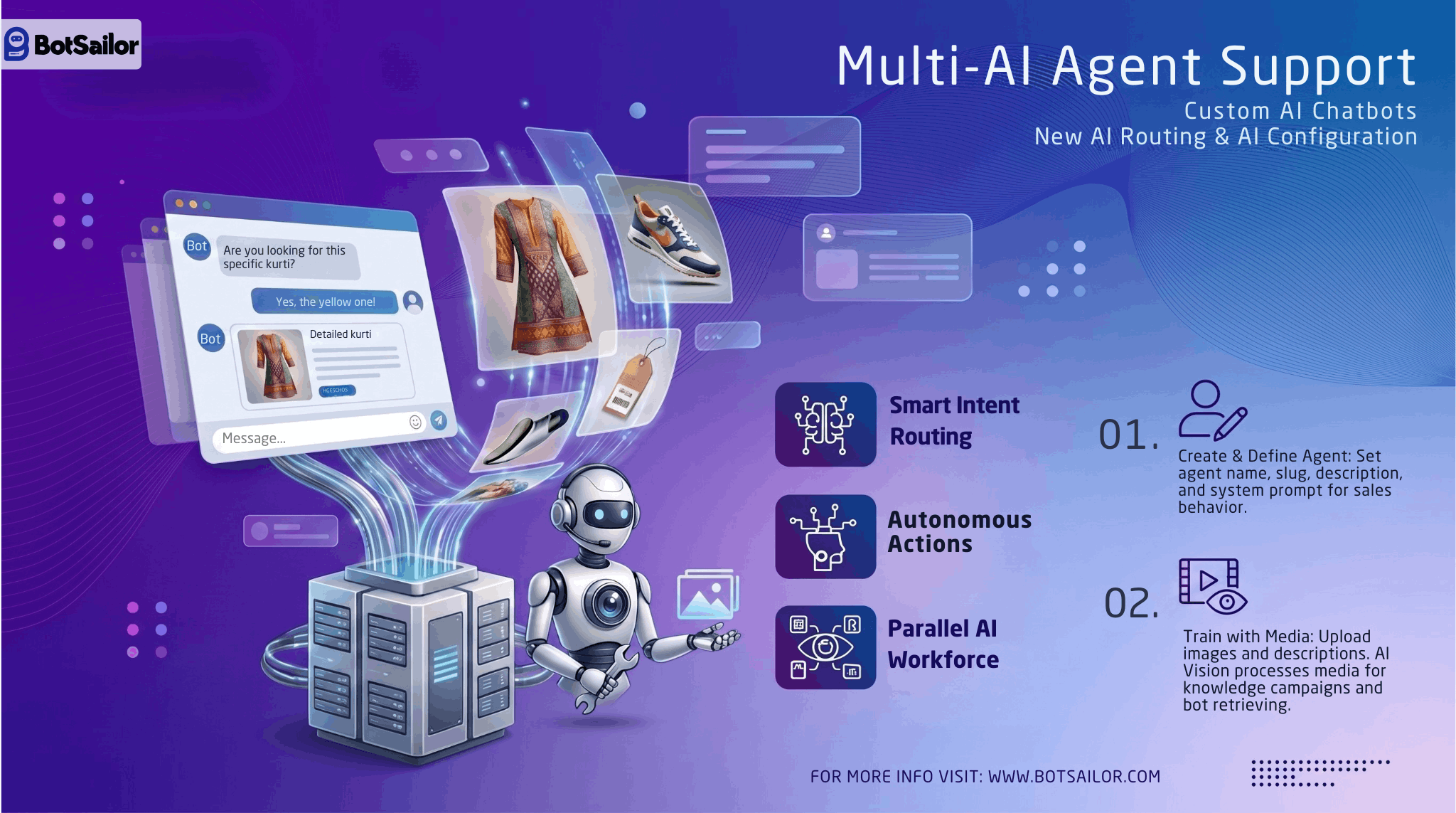
From AI That Answers to AI That Gets Work Done
AI-powered customer communication is changing quickly.
For the last several years, businesses have used AI primarily to answer questions, provide information, and reduce repetitive support work. But answering a customer is only one part of a real business conversation.
A sales representative may need to understand requirements, collect information, qualify a prospect, update customer records, schedule a follow-up, or transfer the opportunity to another team.
A support representative may need to ask for an order number, check an external system, explain the result, and escalate the conversation when something goes wrong.
That is the direction we have taken with the latest evolution of BotSailor AI Agents.
Xerone IT has transformed BotSailor’s previous AI-assistant experience into a multi-agent, action-oriented automation system where multiple specialized AI Agents can work together within the same customer journey. (BotSailor)
One Bot Can Now Have an Entire Team of AI Agents
A business does not normally expect one employee to handle sales, technical support, billing, order management, and appointment scheduling equally well.
AI automation should not have to work that way either.
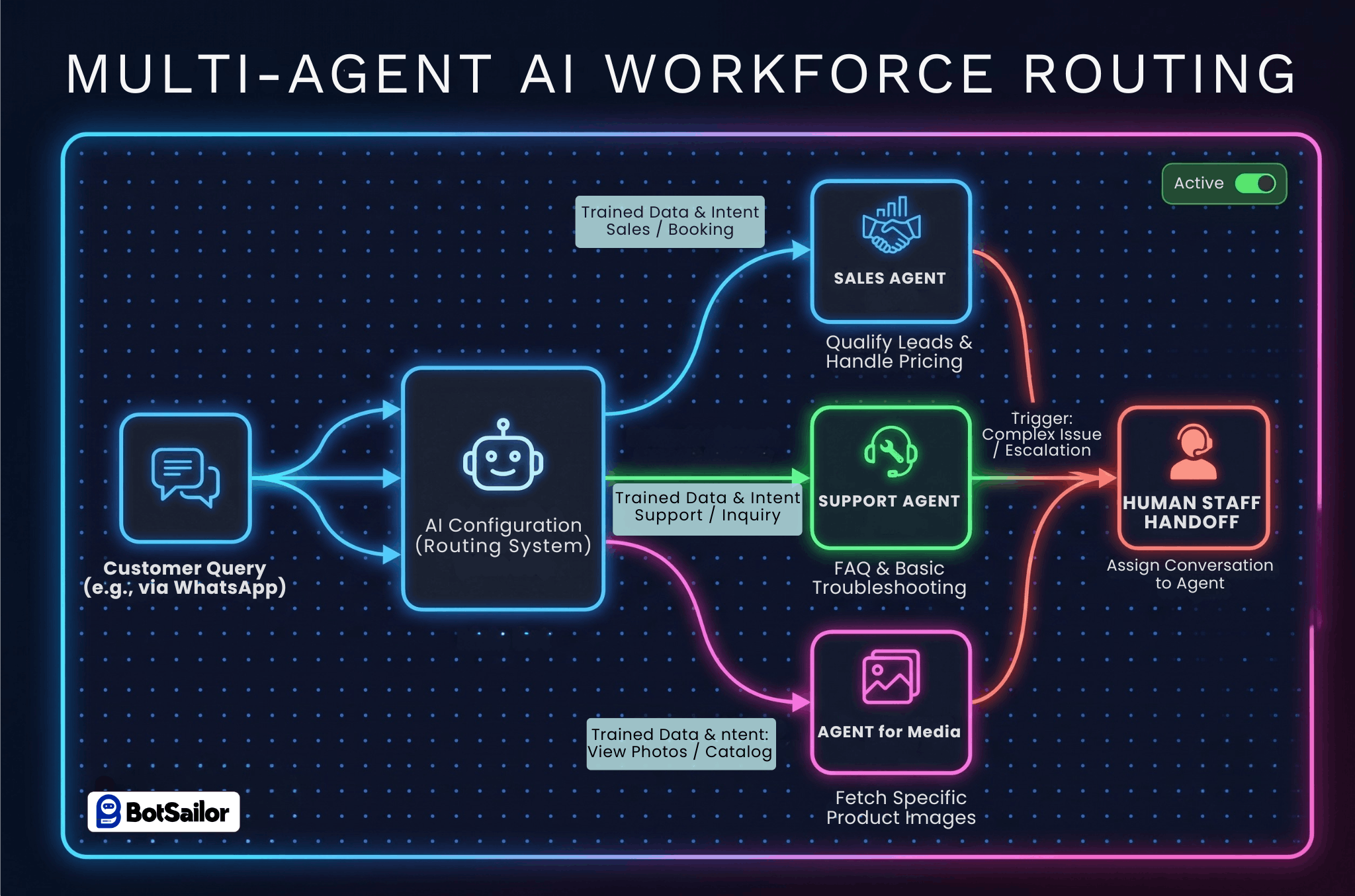
With BotSailor, businesses can create multiple specialized agents such as:
-
Sales Agent
-
Lead Qualification Agent
-
Customer Support Agent
-
Order Status Agent
-
Product Recommendation Agent
-
Appointment Agent
-
Human Handover Agent
Each agent can have its own role, description, system prompt, knowledge source, and responsibilities.
Routing rules determine which agent should handle a particular customer request. If the topic changes during the conversation, another specialized agent can take responsibility without requiring the customer to start the conversation again. (BotSailor)
For example, a customer could begin by asking about a product and speak with the Sales Agent. Later, the same customer may ask about an existing order and the Order Agent can take over. If there is a delivery problem, the conversation can move to the Support Agent or ultimately to a human representative.
That is the idea behind BotSailor’s multi-agent architecture:
One customer conversation, with the right specialist handling each stage.
These AI Agents Can Take Actions
The biggest change is not simply that businesses can create multiple agents.
The agents can also perform business actions.
BotSailor AI Agents can be instructed to:
-
Add or remove customer labels
-
Save information into custom fields
-
Assign or remove automated sequences
-
Call configured HTTP APIs
-
Trigger BotSailor bot flows or postbacks
-
Assign conversations to human agents or teams
-
Send relevant images
-
Continue conversations using information returned from APIs
These capabilities connect AI reasoning directly with BotSailor’s existing automation ecosystem. (BotSailor)
Consider an order-tracking conversation.
The AI Agent can ask the customer for an order number. If additional information is required, it can continue asking until it has everything necessary.
It can then save the collected information, call the configured order-status API, interpret the response, and explain the status naturally to the customer.
If the API indicates a problem, the agent can label the conversation and assign it to the appropriate support team.
The conversation therefore moves from:
Question → Understanding → Information Collection → Action → Result
rather than stopping after an AI-generated reply.
The System Prompt Becomes the Agent's Operating Instructions
One of the most important parts of the new system is the System Prompt.
In BotSailor, the prompt does much more than specify whether an AI should sound friendly or professional.
It can define:
-
What the agent is responsible for
-
What information it needs
-
Which questions it should ask
-
When enough information has been collected
-
How it should use its knowledge source
-
When a particular action should run
-
When an API should be called
-
When a bot flow should start
-
When another agent or human should take over
Actions can be placed directly inside these instructions.
For example, the prompt could conceptually tell an agent:
When the customer has provided all required qualification information and shows clear purchase intent, mark the customer as a qualified lead and start the appropriate follow-up sequence.
BotSailor connects those natural-language conditions with exact actions configured inside the platform. The product uses action syntax such as ##action_name## : selected_value, with autocomplete helping users select the correct labels, fields, sequences, APIs, flows, or human assignments. (BotSailor)
Business Knowledge Is Part of Every Agent
An intelligent agent also needs the right information.
BotSailor allows individual AI Agents to be connected with their relevant Knowledge Campaigns.
This means a Sales Agent can be trained with product information, pricing, features, and comparisons, while a Support Agent can work with documentation, FAQs, policies, and troubleshooting information. BotSailor's AI Agent configuration supports agent-specific knowledge campaigns. (BotSailor)
This separation is important.
The knowledge source tells the AI what it knows, while the System Prompt tells it how to behave and what to do with that knowledge.
Combined with actions and APIs, this allows an agent to use different types of information appropriately:
Knowledge Base → general business information
Conversation Context → what the customer has already told the AI
Custom Fields → structured customer information
HTTP API → real-time or external business data
System Prompt → instructions that connect everything together
AI Agents Can Collect Information Naturally
Traditional automation often requires a fixed sequence:
Question 1 → Answer → Question 2 → Answer → Question 3 → Answer
Real human conversations do not always happen in that order.
A customer may provide several pieces of information in a single message, skip something important, give an unclear answer, or change the subject.
BotSailor AI Agents can be instructed to manage this more naturally.
An agent can be trained to:
-
Recognize information the customer has already provided
-
Avoid unnecessarily repeating questions
-
Ask only for information that is still missing
-
Ask clarification questions when an answer is incomplete
-
Continue until all required information is available
-
Save collected values into the appropriate customer fields
-
Perform the next action only after its requirements are satisfied
This makes it possible to automate processes such as qualification, order lookup, booking, product discovery, onboarding, and support without forcing every customer through the same rigid conversational path.
AI and Traditional Automation Can Work Together
We do not believe every business process should be replaced by generative AI.
Some processes work better as structured automation.
That is why BotSailor AI Agents can trigger existing bot flows and work alongside the platform’s labels, custom fields, sequences, APIs, human teams, and other automation features. (BotSailor)
The AI can handle the flexible part:
Understand what the customer wants.
Then BotSailor can use deterministic automation when appropriate:
Run the checkout flow.
Start the booking process.
Assign the follow-up sequence.
Update customer information.
Call the external system.
This combination of conversational intelligence and structured automation is an important part of how we see the next generation of customer engagement systems developing.
Practical Multi-Agent Use Cases
The architecture can be applied across different industries and customer journeys.
An e-commerce business could have a Product Recommendation Agent, Order Status Agent, and Support Agent.
A SaaS company could use a Receptionist Agent, Sales Qualification Agent, Technical Support Agent, and Human Handover Agent.
A service business could create Lead Qualification, Appointment Booking, and Customer Support Agents.
Each business can define its own agent structure instead of being limited to a predefined collection of AI assistants.
Building a Multi-Agent AI Workforce
Creating multiple agents is only the beginning.
Businesses also need to think about:
-
Which agents they actually need
-
What responsibility belongs to each agent
-
How conversations should be routed
-
Which knowledge source each agent should receive
-
Which actions each agent should be allowed to execute
-
What information needs to be collected
-
When AI should hand the conversation to a human
Our Direction: AI That Participates in Business Processes
For us at Xerone IT, the goal is not simply to add AI-generated responses to existing chatbot software.
We want AI to become a practical part of business automation.
That means connecting conversational intelligence with knowledge, customer data, APIs, workflows, follow-up automation, and human teams.
BotSailor’s Multi-Agent AI system is an important step in that direction.
Instead of asking:
“Can the AI answer this customer?”
businesses can begin asking:
“Can the AI understand what this customer needs and complete the next steps?”
With specialized agents, prompt-controlled behavior, knowledge sources, API connectivity, workflow execution, and human handover, BotSailor is moving toward that second model. (BotSailor)
Explore BotSailor Multi-Agent AI
See how the complete system works, explore available actions, and discover practical use cases:
Explore the BotSailor AI Agents Platform
One Bot. Multiple AI Agents. Real Business Actions.
That is the next stage of AI-powered customer automation we are building with BotSailor.


0
288
Project Management